


From the Archive: Texture of Consciousness
- 38shurley
- May 31
- 4 min read
Updated: 21 hours ago
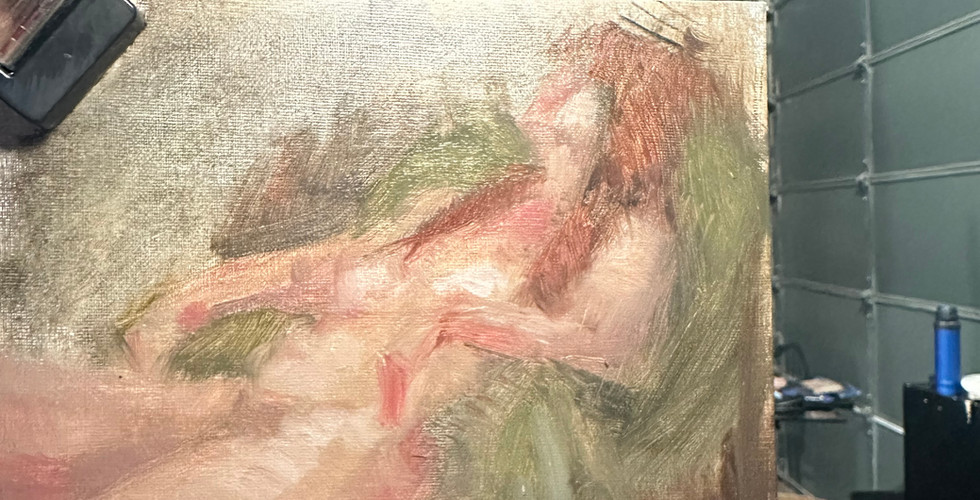
This is an essay I wrote about how my first term at an Atelier drawing program connected feelings I had been having about my creative experiences for a few years. In its essence: I was learning a visual language. Now, I would like to start with that language to show you my translation of life into painting with this 3 hour study of the muse Larissa from 2025.




"Words click into place when images and form mislead me. Oscillating between mediums has always been a way I moved through periods of plateau. Drawing, scrapbooking, reading, writing, painting, poetry, then back to drawing again. Usually following periods of depression or anxiety writing would take over my thoughts for months as I would scribble every thought in a little pocket journal or new notes app page like it was about to be whisked away by the wind. Before words became stale I wrote some poems, eventually, happy ones.
Poems began flowing when I started looking at the characterization of my rag, or the pattern of how lines of a poem end and indent from one to another. Modern poetry favors an almost-rhythm, a bit of randomness but not overwhelmingly so. I wrote random lines of poetry constantly when I was living by the beach in my early twenties. Watching the sunset every night with friends gathered the loose ends of my sporadic thoughts. I remember these times so clearly as the constellation of Orion’s crotch (our inside joke of Orion’s belt) began to slowly appear above us on the drive home. One night a thought hit me like the coastal wind so strong it threatened to tear my thoughts away:
Words were my consciousness made smooth.
They took infinite feeling and rubble and sediment of memory and turn it into a thing. A word is a whole thing. In psychology they call this Orthographic Processing. At least, once we learn to read, we stop separating the letters. This leads to phenomena like typoglycemia and graphemic restoration where our mind jumbles or fills in gaps in words seamlessly. We unify, symbolize the unique pattern of a word as a shape in context and not as a series of letters.
Living and writing are two different art forms, mediums to create with. So of course, writing won’t get it all, it won’t be the same, but it can smooth out the static. It can take memories of the most complex feelings and turn them into the rag of a poem. Now there are little rocks of words making a horizon line that I can look for when I walk home.
This line has been rewritten in my journals and word documents for years, “the texture of my consciousness made smooth”. And over those years, I shifted from writing back to images, now working on images full time as a figurative and visual artist. When people ask about my references and photographs and the idea for paintings I keep on saying photography and painting are two different mediums. A great photo won’t always make a great painting. Two mediums can work in tandem, but translating between them will always come at a cost.
Last night the two ideas collided in my mind – writing and life being the same relationship as image and painting. After a figure drawing class my teacher invited students back to his studio to critique a student’s portrait painting and show us how he would improve it. It was quiet, wide white walls reminding me of a hospital. This place for professionals to make and do, probably the most prestigious one in town. We set up a quick limited pallet and asked questions while the teacher divided a three-quarter turned face like a sphere study with a beak, then slowly developed character with what looked like a brown puddle of paint. Less is more, see the form, turn the planes.
We talked about decisions he made differently from the photo reference and why. Then it hit me. Why painting a photo, painting a moment, Impressionism, realism, portraiture, all of it is translation. It is turning your thoughts into poetry. It is the texture of consciousness made smooth with linseed oil. The texture of digital photography, film grain, pixels, points of color made smooth with a brush. They are different mediums simplifying one another, explaining one another like letters becoming words becoming symbols becoming language becoming the most important tool of humanity. In the moment I tried to say it and the words stumbled and landed like rubble, but I came home and wrote this.
The Sapir-Wharf hypothesis proposes a language’s breadth of words limits your consciousness’s ability to understand reality. It has been debunked over and over, but I think things were close. Language allows us to make sense of reality. Painting allows us to make sense of the visual world. It is a medium of understanding not control. This blog platform is an attempt to become literate in visual art, to increase literacy, to cultivate this language and practice it with strangers. Like ordering coffee in a foreign language for the first time, I will stumble and get things wrong, I am open to critique."
Comments